
Search Wayne County Court Records
Wayne County does not publish one county-branded public case search for every civil and criminal file. The practical search route is a mix of the Clerk of Superior Court / Clerk of Courts, the Judicial Division, Georgia Courts e-access, re:SearchGA, PeachCourt, Probate Court, Magistrate Court, Municipal Court, and the Sheriff's Office. The right channel depends on whether the record is a Superior Court divorce, a State Court misdemeanor, a probate estate, a jail booking, a traffic citation, or a city matter.
The Wayne County Judicial Division says it receives, files, stores, and retrieves civil and criminal records for Superior Court, State Court, Drug Court, and juvenile matters. Juvenile records are the major public-access exception. Public users should ask for a specific case by party name, case number if known, court, case type, and filing year. A broad criminal-history search is not the Clerk's role.
- Identify the court first: Superior, State, Magistrate, Probate, Juvenile, Municipal, or Drug Court.
- For Superior and State Court files, contact the Clerk of Courts or use Georgia e-access and re:SearchGA if the case is available online.
- For filings and document workflow, use PeachCourt where Wayne Superior or State Court e-filing applies.
- For probate, marriage, guardianship, and vital-certificate matters, use Wayne County Probate Court.
- For jail booking details or current custody, use the Wayne County Sheriff's inmate inquiry and jail phone fallback.
The Wayne County Clerk of Court homepage is one of the main starting points for court, e-filing, jury, and traffic links.
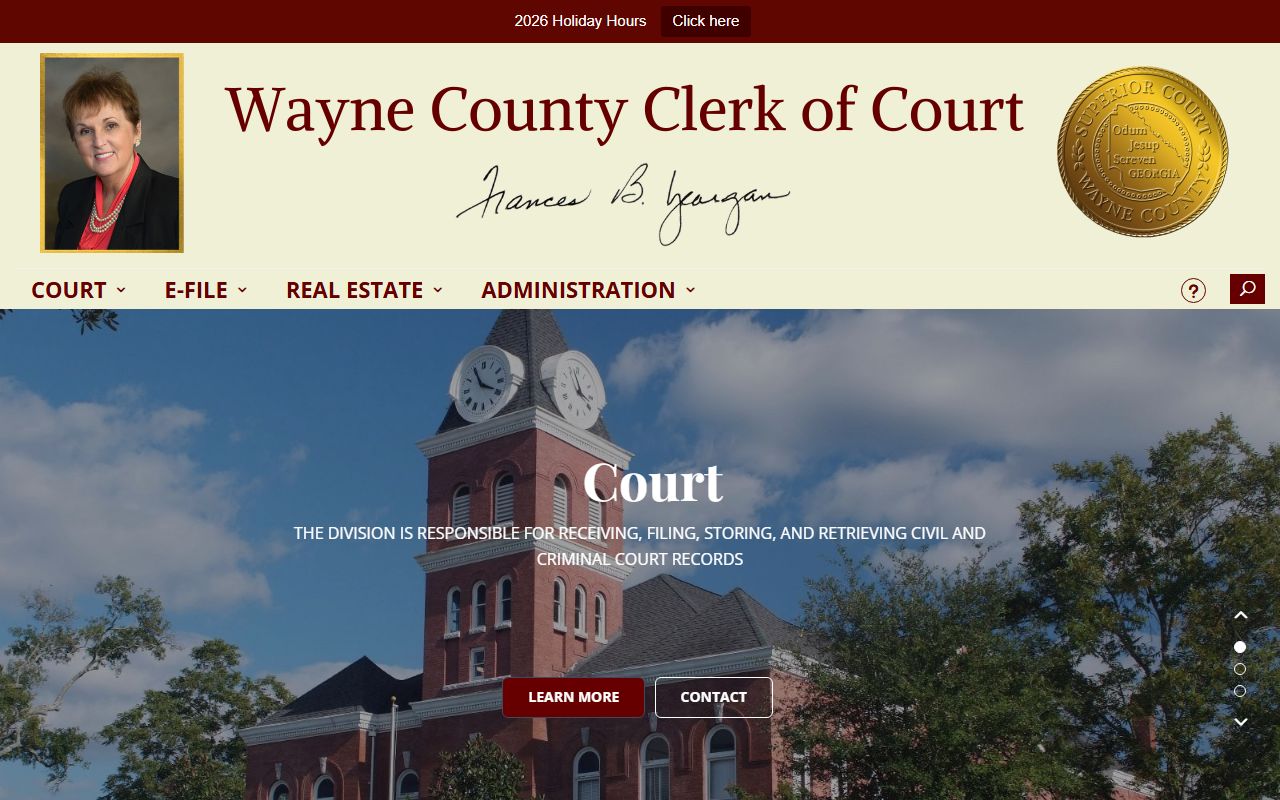
The Clerk's separate site matters because Wayne County uses both the county-government courts pages and a dedicated Clerk site for court services.
Wayne County Court System
Georgia does not use a county district court model for Wayne County trial records. The closest general trial court is Superior Court. Wayne County Superior Court is part of the Brunswick Judicial Circuit with Appling, Camden, Glynn, and Jeff Davis counties. It handles felony criminal cases, divorce, equity, land-title matters, child custody and adoption issues, and many civil matters.
State Court handles misdemeanors, traffic citations, and civil matters not reserved to Superior Court. Magistrate Court is important for lower-level civil and criminal matters and for many warrants. Probate Court keeps estate, guardianship, marriage, vital-certificate, weapons carry, and mental-health probate records. Jesup Municipal Court handles city cases. Appeals normally move to the Court of Appeals of Georgia unless a case type goes to the Supreme Court of Georgia.
| Court | Wayne County Role | Common Records |
|---|---|---|
| Superior Court | General jurisdiction in the Brunswick Judicial Circuit | Felonies, divorce, equity, land title, custody, adoptions |
| State Court | Misdemeanor, traffic, and civil jurisdiction | Accusations, traffic citations, fines, misdemeanor calendars |
| Magistrate Court | Lower court and warrant-related work | Initial criminal matters, some civil claims, misdemeanor warrants |
| Probate Court | Estate, license, and probate jurisdiction | Wills, estates, guardianships, marriage licenses, vital certificates |
| Municipal Court | City of Jesup court matters | Municipal citations and possible city bench warrants |
Case flow: arrest or filing › Magistrate, Municipal, Probate, State, or Superior Court routing › docket entries › hearing, plea, trial, order, or judgment › appeal when allowed.
Start With the Right Office
Wayne County court records often sit in nearby but separate offices in Jesup. The trial-court records counter is tied to the Clerk of Courts at the courthouse on North Brunswick Street. Probate Court is on East Walnut Street. The Sheriff's Office is also on East Walnut Street, while the jail is south of downtown on South Macon Street. A record search can fail if the request goes to the right county but the wrong custodian.
Clerk of Courts
174 N Brunswick St
Jesup, GA 31546
(912) 427-5930
Monday-Friday 8:30 a.m.-5:00 p.m.
Probate Court
359 East Walnut Street
Jesup, GA 31546
(912) 427-5940
Arrive by 4:30 p.m. for processing.
Wayne County Jail
1892 South Macon Street
Jesup, GA 31545
(912) 427-5975
Call for custody, visitation, and booking questions.
Wayne County Record Types
Wayne County court records include civil files, criminal files, domestic relations, probate files, traffic citations, jail booking records, warrant-related records, and appellate materials. The record type controls both the office and the search method. A divorce decree is a Superior Court domestic civil record. A marriage license is a Probate Court record. A current jail booking is a sheriff or jail record, not a final court disposition.
The county's Judicial Division lists Superior Court civil records such as general civil cases, domestic civil matters, name changes, legitimations, family violence petitions, lis pendens, felony indictments, and subpoenas. State Court records include general civil cases, misdemeanor accusations, contempt, modifications, and subpoenas. Drug Court files involve rehabilitation and drug screening records, which may carry extra limits because of treatment content.
- Civil records: complaints, answers, service returns, motions, orders, judgments, and costs.
- Criminal records: warrants, accusations, indictments, pleas, hearings, dispositions, sentences, and probation terms.
- Family records: divorce, alimony, child support, custody, adoption, modification, contempt, and family violence files.
- Probate records: estates, wills, guardianships, conservatorships, marriage licenses, weapons carry, and vital certificates.
- Traffic records: State Court and municipal citation records, fine status, court dates, and DDS-related consequences.
What Wayne County Court Records Show
A Wayne County case file can show the court, case number, filing date, party names, case type, docket events, documents, financial entries, and final result. Criminal records can include a charging instrument, bond orders, motions, plea entries, trial notes, disposition, sentence, restitution, probation, and appeal entries. Civil records can include pleadings, service returns, motions, orders, judgments, and cost entries.
| Field | What It Shows |
|---|---|
| Court | Superior, State, Magistrate, Probate, Juvenile, Municipal, or Drug Court. |
| Case type | Civil, domestic, felony, misdemeanor, probate, guardianship, traffic, or related category. |
| Docket entry | A dated filing, motion, order, hearing, arraignment, plea, continuance, judgment, sentence, or appeal event. |
| Disposition | The final result of a charge, claim, petition, or case. |
| Financial entry | Filing costs, service fees, fines, bond, restitution, transcript fees, or certification fees. |
| Restriction | A sealed, restricted, juvenile, adoption, mental-health, or redacted record status. |
Wayne County Public Access
Georgia public-record law is broad, but it is not unlimited. O.C.G.A. 50-18-70 states the open-records policy and definitions. O.C.G.A. 50-18-71 covers inspection, copying, timing, and allowed fees. O.C.G.A. 50-18-72 lists exemptions. Court files can also be controlled by court rules, sealing orders, and special statutes.
Wayne County's most practical public-access rule is local: the Judicial Division says records are open for public inspection and copying except juvenile court records, which are not publicly accessible. For agency records outside a case file, use Georgia Open Records Act request channels. For certified court copies, use the court office that keeps the original record.
Key Statutes:
O.C.G.A. 35-3-37 governs criminal-history restriction and sealing in Georgia.
O.C.G.A. 15-11-704 limits public inspection of juvenile court files and records.
O.C.G.A. 50-18-71 is the main timing and fee rule for public-record inspection and copying.
Restricted Wayne County Records
Some Wayne County records are not ordinary public records. Juvenile court records are confidential under the local Judicial Division statement and Georgia juvenile law. Juvenile hearings are not open to the public. Adoption records, mental-health probate matters, medical or incapacity details, protected victim information, Social Security numbers, financial account data, and minor-related facts may be sealed, withheld, or redacted.
Georgia often uses the term record restriction for what many people call expungement. A person seeking restriction usually needs the arrest, charge, court, arresting agency, prosecutor, and disposition. Eligibility depends on the result. Dismissed, nolle prosequi, dead-docketed, acquitted, and some other categories may qualify, while convictions are more limited. Court, jail, agency, and private copies may not all change at the same time.
Note: Online absence does not prove that no Wayne County court record exists.
Wayne County Specialty Programs
Wayne County has Drug Court, and the Judicial Division lists Drug Court records as rehabilitation program and drug screening records. The Clerk site also publishes Drug Court materials for the Brunswick Model, team, outcomes, and program outline. These records should be treated with more care than ordinary civil filings because they can involve treatment, screening, supervision, and compliance information.
The Solicitor-General page also identifies a local Family Violence Counseling Program that began in 1994 with the State Court Judge and State Court Probation Office. It allows a first-time offender to attend anger and violence counseling as an alternative to prosecution. If the person fails to attend or commits a new offense, the case returns for prosecution.
Wayne County Sheriff and Jail
The Wayne County Sheriff's Office county page names Sheriff Robert Chuck Moseley. The sheriff site lists the office at 266 E Walnut St in Jesup, with phone 912-427-5970. Wayne County Jail is listed by the Georgia Department of Corrections at 1892 South Macon Street, Jesup, with phone (912) 427-5975. Jail custody records and booking details are searched through the sheriff's inmate inquiry route, not through the Clerk's civil and criminal case files.
The Wayne County Sheriff's Office homepage links public safety and inmate resources used for Wayne County jail records.
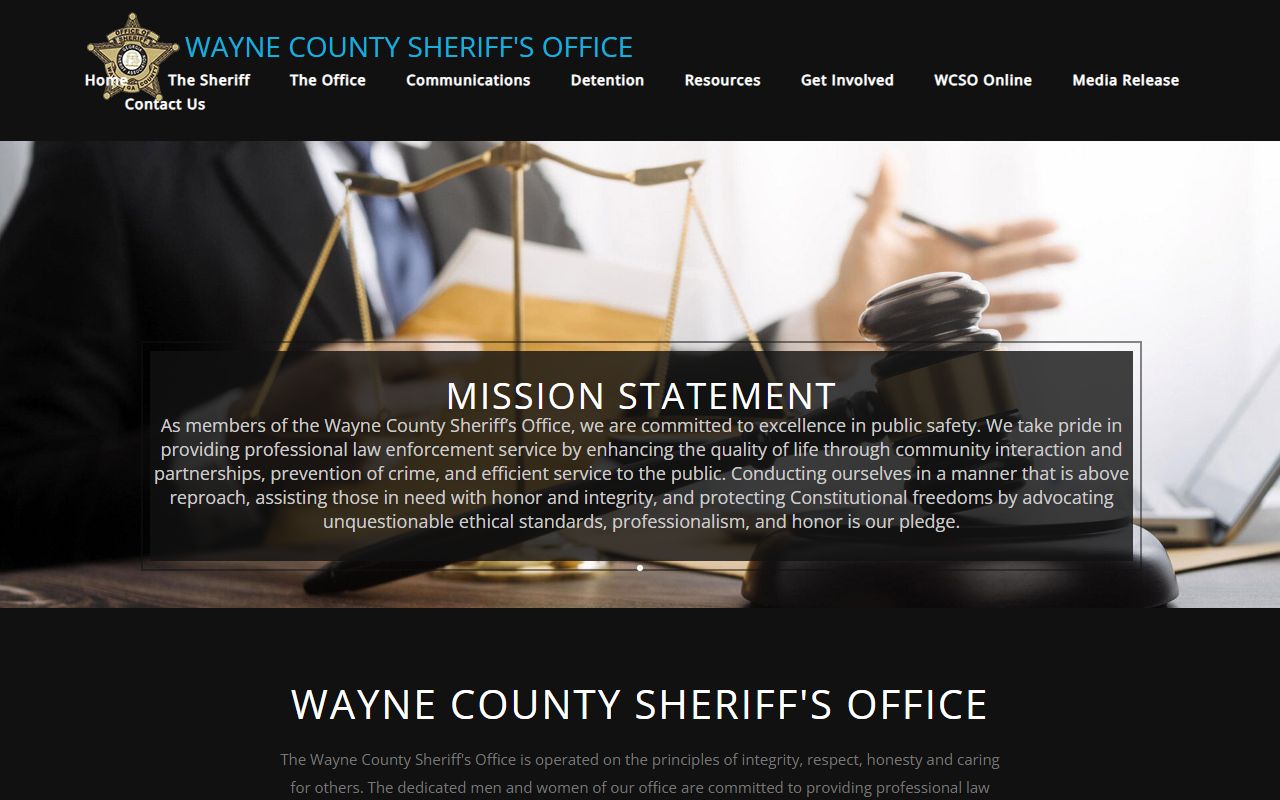
County court users often need both the court and sheriff paths because a booking charge can exist before a complete court case record is available.
Marriage Divorce and Probate
Marriage licenses and many probate matters are handled by Wayne County Probate Court, not the Clerk of Courts. The probate office handles probate of wills, estate administration, guardianships, conservatorships, marriage licenses, weapons carry licenses, birth and death certificates, and involuntary hospitalization matters. Divorce files are different. They are Superior Court domestic civil records handled through the Clerk and Judicial Division.
Wayne Probate Court charges $76 for a marriage license without premarital counseling and $36 with premarital counseling. Applicants need proof of age through a driver's license, passport, or other current photo ID. The office asks visitors to arrive by 4:30 p.m. so staff can process the request before closing.
- Executor
- A person appointed to carry out a will or estate duty.
- Guardianship
- A probate appointment to make personal decisions for another person.
- Conservatorship
- A probate appointment to manage another person's property or money.
Wayne County Court Fees
Fees vary by court and service. The Clerk fee pages list civil filing, transfer, appeal, recording, subpoena, transcript, and certification costs. Probate Court has a separate fee schedule for estate, guardianship, conservatorship, mental-health, and other probate filings. A record request should include the exact document needed so the office can quote copy, certification, transcript, or search costs that apply.
| Item | Amount |
|---|---|
| General civil filing | $207 plus applicable service fees |
| Family violence petition | No fee |
| Recording per page | $1.50 |
| Subpoena | $5 |
| Appeal record preparation | $1 per page |
| Seal and certification | $2 in addition to other costs |
Wayne County Traffic Records
Traffic records in Wayne County are split between a court traffic record and the Georgia DDS driver record. The court record is kept by Wayne State Court, the Clerk, or Municipal Court for the citation case. It can show citation details, charge, statute, court date, plea, disposition, fine, court costs, failure to appear, and related orders. DDS keeps license status, points, suspensions, and driver history.
The Solicitor-General prosecutes State Court misdemeanors and traffic cases. Sources include Wayne County Sheriff's Department, Wayne County Board of Education Police, Georgia State Patrol, Georgia DNR, county park rangers, animal control, DA transfers, Macon Municipal Court transfers, and Magistrate transfers. Payable citations may be resolved online, but DUI, suspended license, fleeing and eluding, and leaving the scene are examples that require more court attention.
Federal Records Are Separate
Federal court records are not Wayne County court records. Wayne County is in the U.S. District Court for the Southern District of Georgia, and federal appeals go to the U.S. Court of Appeals for the Eleventh Circuit. Bankruptcy cases are handled by the U.S. Bankruptcy Court for the Southern District of Georgia. Federal case records are searched through PACER or federal court channels, not the county Clerk.
FCI Jesup is located in Wayne County, but federal prison custody records are separate from the Wayne County Jail roster. A person moved from county jail to federal custody should be searched through federal inmate tools or the Bureau of Prisons, while county booking questions still go to the jail.
Wayne County Court History
The City of Jesup courthouse history page identifies the Wayne County Courthouse on Brunswick Street as a 1902-1903 building that replaced an earlier wooden courthouse across the street.

The courthouse history is useful for visitors because the trial-court records counter remains tied to the downtown courthouse area even though related offices sit in nearby buildings.
Wayne's records history also includes technology changes. Georgia civil e-filing for new Superior and State Court cases became mandatory for attorneys and self-represented litigants by January 1, 2019. Georgia plats moved to mandatory electronic filing through GSCCCA effective January 1, 2017. Those changes explain why older paper records may require a counter request while newer filings may have an electronic workflow.
Wayne County Online Sources
The Wayne County official government site is the local hub for department pages, contact information, county alerts, and court department links.

The county site helps confirm office structure, but the dedicated Clerk, Probate, Sheriff, and statewide court portals still need to be used for specific record tasks.
The Wayne County local court information page points users toward court fees, forms, jury information, and related court topics.
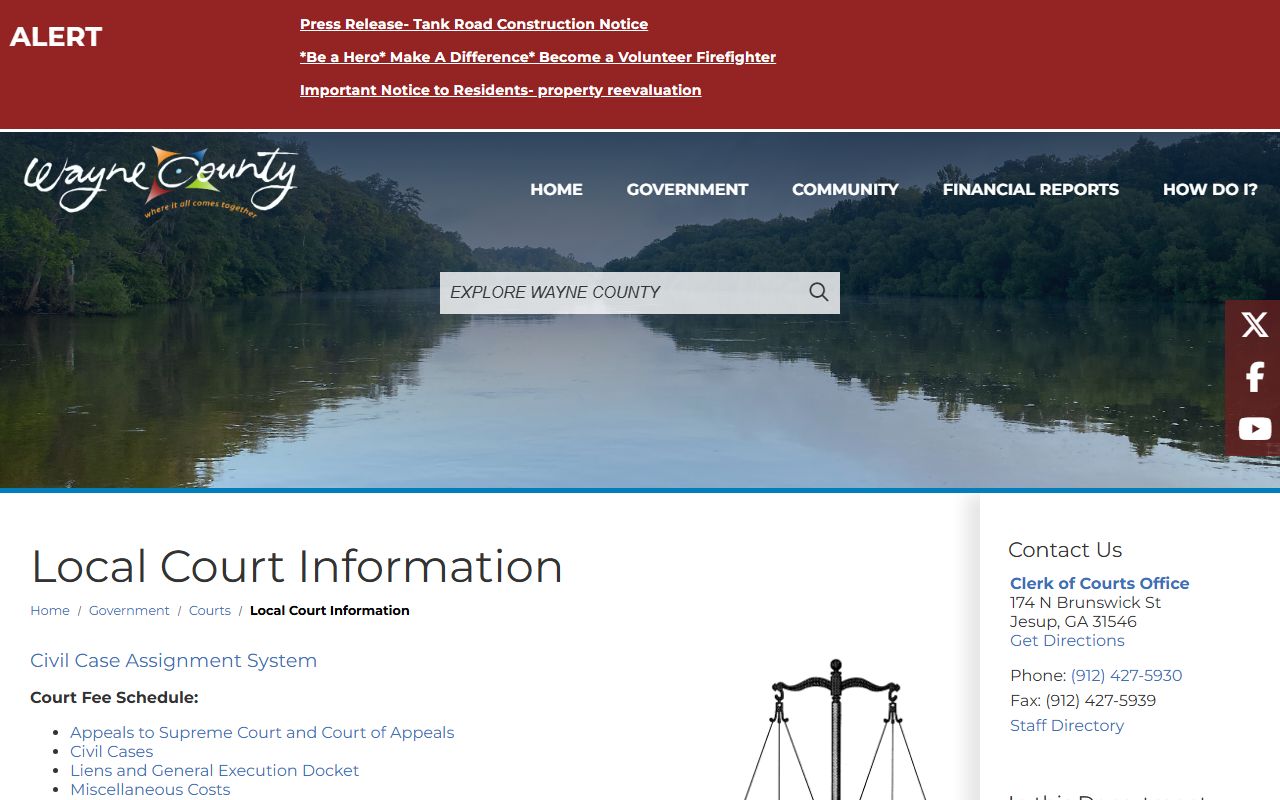
Using the local court pages with the Clerk and statewide portals gives a more complete path than relying on one database.
Wayne County Court FAQ
Can Wayne County court records be searched online? Some access is online through Georgia e-access, re:SearchGA, PeachCourt workflows, GSCCCA indexes, the inmate roster, and traffic payment links. The Clerk remains the fallback for older files, certified copies, and records not visible online.
Where are Wayne County divorce records kept? Divorce records are Superior Court domestic civil files. Search through the Clerk of Courts or Georgia e-access when available, not Probate Court.
Are juvenile records public in Wayne County? No. Wayne County states that juvenile court records are confidential and not publicly accessible, with access limited to juvenile and court officials.
Who handles Wayne County warrants? Active warrant questions start with the Sheriff's Office. Magistrate Court, State Court, Superior Court, and Jesup Municipal Court may also be involved depending on the type of warrant.
What is the difference between a charge and a conviction? A charge is an accusation or count filed after an arrest or court action. A conviction is a final guilty result by plea or trial.
How are certified copies requested? Certified court copies come from the office that keeps the official record, such as the Clerk of Courts for Superior or State Court files and Probate Court for probate or marriage records.