
Criminal Court Records in Wayne County
A Wayne County criminal court record begins when a criminal matter is filed into court and tracked by the proper clerk or court office. Superior Court handles felony criminal cases in the Brunswick Judicial Circuit. State Court handles misdemeanor criminal cases and traffic citations. Magistrate Court is important for initial warrants and lower-level criminal processing, while Jesup Municipal Court handles city matters. The Clerk of Superior Court / Clerk of Courts keeps criminal files for Superior Court, State Court, and Drug Court, but the Clerk does not conduct broad misdemeanor or felony criminal-history searches. A public user should request a specific case by defendant name, case number if known, court, case type, and approximate year.
The District Attorney prosecutes felony criminal matters for the Brunswick Judicial Circuit and serves as legal advisor to the grand jury. The Wayne County District Attorney office is listed at 145 N Brunswick St, Jesup, GA 31546, phone (912) 427-6379, Monday through Friday, 8:30 a.m. to 5:00 p.m. The Solicitor-General prosecutes exclusively in Wayne County State Court. Solicitor Andy R. Beaver's office is at 174 N Brunswick St, Jesup, phone (912) 427-5928, fax (912) 427-8893. State Court misdemeanors include DUI, theft of goods or services, marijuana possession less than one ounce, battery including domestic violence, criminal trespass, hunting and fishing violations, and traffic violations.
How to Search Wayne County Criminal Court Records
For public Superior and State Court criminal files, use the Clerk of Courts at 174 N Brunswick St, Jesup, phone (912) 427-5930, or the Georgia Courts e-access / re:SearchGA account workflow where Wayne County data is available. Use PeachCourt for filing and document workflow, including authorized Wayne Superior Court criminal e-filing. If the question is only whether someone is currently in custody, the jail roster is the better starting point. If the question is active warrant status, use the Sheriff's Office or court of issue rather than assuming the case docket is current.
- Identify whether the matter is a felony in Superior Court, misdemeanor in State Court, initial warrant in Magistrate Court, municipal case, or federal case.
- Search by defendant name or case number through the available account-based court system, or contact the Clerk with those details.
- Narrow by court, case type, filing year, and prosecutor office when common names produce multiple results.
- Open the case activity to read charges, docket events, pleas, motions, disposition, sentence, probation, fines, costs, and appeal entries.
- Request certified copies from the Clerk if the record will be used as formal proof of a disposition or sentence.
Statewide criminal-history access is different from a court case file. Wayne's Clerk does not run broad criminal-history searches, and O.C.G.A. 35-3-37 affects restriction and sealing of criminal-history information. A specific court disposition may still need to be gathered from the court that handled the case.
Stages of a Criminal Case
A criminal case can begin with an arrest, warrant, citation, accusation, indictment, or transfer. The court record grows as the matter moves through formal charge filing, arraignment, motions, hearings, plea or trial, disposition, sentencing, and appeal. Wayne County's local misdemeanor ecosystem is specific: State Court cases can include misdemeanor warrants initiated in Magistrate Court, sheriff citations, Georgia State Patrol citations, Board of Education Police citations, Department of Natural Resources citations, park ranger and animal control citations, District Attorney transfers, Macon Municipal Court transfers, and Magistrate transfers.
Case flow: Charges Filed › Arraignment › Pretrial / Motions › Plea or Trial › Disposition › Sentencing
| Stage | What Happens |
|---|---|
| Charges Filed | An accusation, indictment, warrant-based filing, citation, or transfer opens the court case or moves the matter into the prosecuting court. |
| Arraignment | The defendant is formally called on the charge and enters a plea such as guilty, not guilty, or nolo. |
| Pretrial / Motions | Parties file motions, request hearings, address bond or evidence issues, and prepare for plea, non-jury trial, or jury trial. |
| Plea or Trial | The case resolves by plea, bench trial, jury trial, dismissal, nolle prosequi, acquittal, or another disposition. |
| Sentencing | The court enters punishment after conviction, which may include confinement, probation, fines, fees, restitution, counseling, or other terms. |
| Appeal / Remittitur | Appeal activity may create record preparation, transcript, certification, and remittitur entries before jurisdiction returns to the trial court. |
What a Wayne County Criminal Court Record Shows
A full criminal case file can include the warrant, accusation or indictment, charging instrument, pleas, bond orders, motions, hearing notices, trial entries, disposition, sentence, probation terms, fines, fees, restitution, and appeals. It may also show prosecutor, defense, victim-notice events, or restricted entries. Jail booking records may show charge and warrant details before a full court outcome exists, but booking charge information is not the final court case file.
| Field | What It Shows |
|---|---|
| Case Number | The court-assigned identifier for the criminal case; local format was not located in public Wayne sources. |
| Defendant | The person accused in the criminal case, usually listed against the State of Georgia. |
| Court | Superior Court for felonies, State Court for misdemeanors and traffic, Magistrate for initial warrant matters, or Municipal Court for city cases. |
| Charges | The accusation, indictment, citation, warrant-based charge, statute, description, counts, and offense type where shown. |
| Plea | The defendant's formal answer, such as guilty, not guilty, or nolo. |
| Docket Events | Arraignment, motions, orders, hearings, continuances, trial entries, judgment, sentencing, probation, appeal, and remittitur. |
| Disposition | The final result of a charge or case, including dismissal, nolle prosequi, acquittal, guilty plea, conviction, transfer, or closure. |
| Sentence | Confinement, probation, fines, fees, restitution, counseling, or other court-ordered terms after conviction. |
Charges vs. Convictions
A charge is an allegation or formal accusation. A conviction is a final finding or plea that results in guilt. A Wayne County criminal court record can show charges that were amended, reduced, dismissed, dead docketed, nolle prossed, or ended in acquittal. Do not treat every charge line as a conviction. The current charge pathway is better covered in Wayne County arrest records and court charges, while this page focuses on the court case file and final case activity.
| Charge | Conviction | |
|---|---|---|
| Stage | Accusation, indictment, warrant, citation, or complaint-level filing | Verdict, guilty plea, or other final guilty disposition |
| Proof Level | May begin from probable cause or prosecutor charging decision | Requires a plea or proof beyond a reasonable doubt at trial |
| Record Meaning | Shows what was alleged or filed | Shows the case resulted in guilt and sentencing |
| Possible Outcome | May be dismissed, amended, reduced, or nolle prossed | May produce sentence, probation, fines, restitution, and appeal rights |
Reading Dispositions and Sentences
Disposition terms are the most important part of a criminal case record. Guilty means a conviction by plea or verdict. Not guilty means the charge did not result in conviction after trial. Dismissed means the charge or case was ended without conviction. Nolle prosequi means the prosecutor declined to proceed on the charge. Dead docket means the case is placed inactive under Georgia practice and may require careful confirmation before assuming final closure. Sentencing entries can include confinement, probation, fines, costs, restitution, or participation in a program.
Wayne County has a local Family Violence Counseling Program described by the Solicitor-General. It began in 1994 with cooperation of the State Court Judge and State Court Probation Office. It allows a first-time offender to attend anger and violence counseling group sessions as an alternative to prosecution. If the offender fails to attend as ordered or commits a new offense, the case is sent back for prosecution. That local program can affect how a misdemeanor or family-violence case appears in the court record.
Sealed vs. Expunged Records
Georgia often uses the term record restriction rather than expungement. A restricted criminal-history record may not appear in ordinary public criminal-history access, but court docket entries, court files, jail records, and private copies may not disappear automatically. For Wayne County matters, a person should gather the arrest, charge, court, arresting agency, and disposition before reviewing eligibility under O.C.G.A. 35-3-37. If a petition is required, it is filed in the court with jurisdiction over the case.
| Sealed / Restricted | Expunged | |
|---|---|---|
| Visibility | Limited from ordinary public access under statute or court order | Georgia commonly frames the process as restriction rather than physical destruction |
| Law Enforcement | May retain access for authorized purposes | Not a promise that every government or private copy disappears |
| Eligibility | May involve dismissal, nolle prosequi, dead docket, acquittal, youthful categories, or petition-based relief | Convictions are more limited and may need a court petition |
The image below comes from O.C.G.A. 35-3-37, Georgia's criminal-history restriction statute.
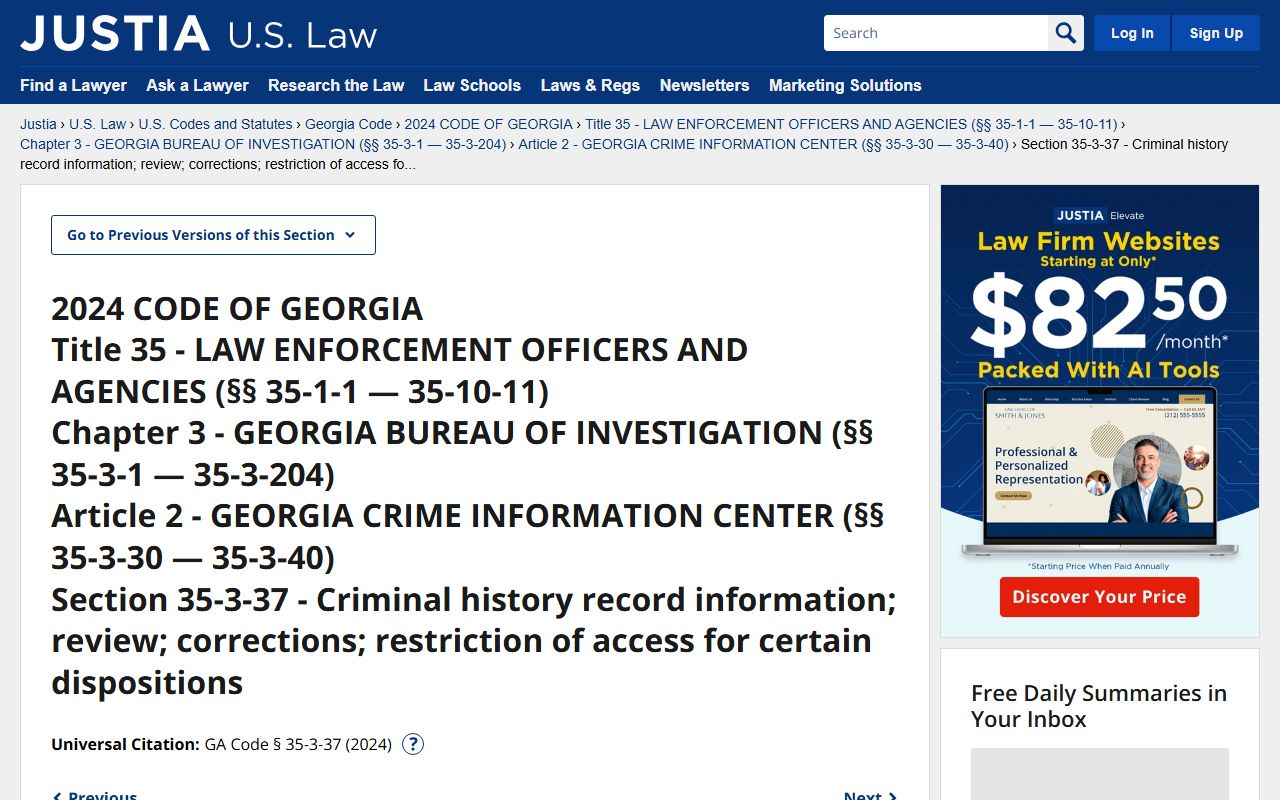
That statute is the key source for explaining why a dismissed or restricted charge may not appear in the same way as an ordinary public criminal case.
Public Access to Criminal Court Records
Public access to Wayne criminal court files starts with the local Judicial Division statement that records are open for inspection and copying except juvenile court records. Georgia Open Records Act provisions, including O.C.G.A. 50-18-70, 50-18-71, and 50-18-72, also shape access to agency records and exemptions. Juvenile court records are separately restricted by O.C.G.A. 15-11-704. Victim information may be handled carefully under O.C.G.A. 17-17-1 and related victims' rights provisions.
Key Statutes:
O.C.G.A. 50-18-70 - Georgia public-record policy is broadly construed in favor of inspection unless a legal exemption applies.
O.C.G.A. 15-11-704 - Juvenile court file and record inspection is limited by statute and court authority.
The image below comes from O.C.G.A. 15-11-704, Georgia's juvenile court record inspection statute.
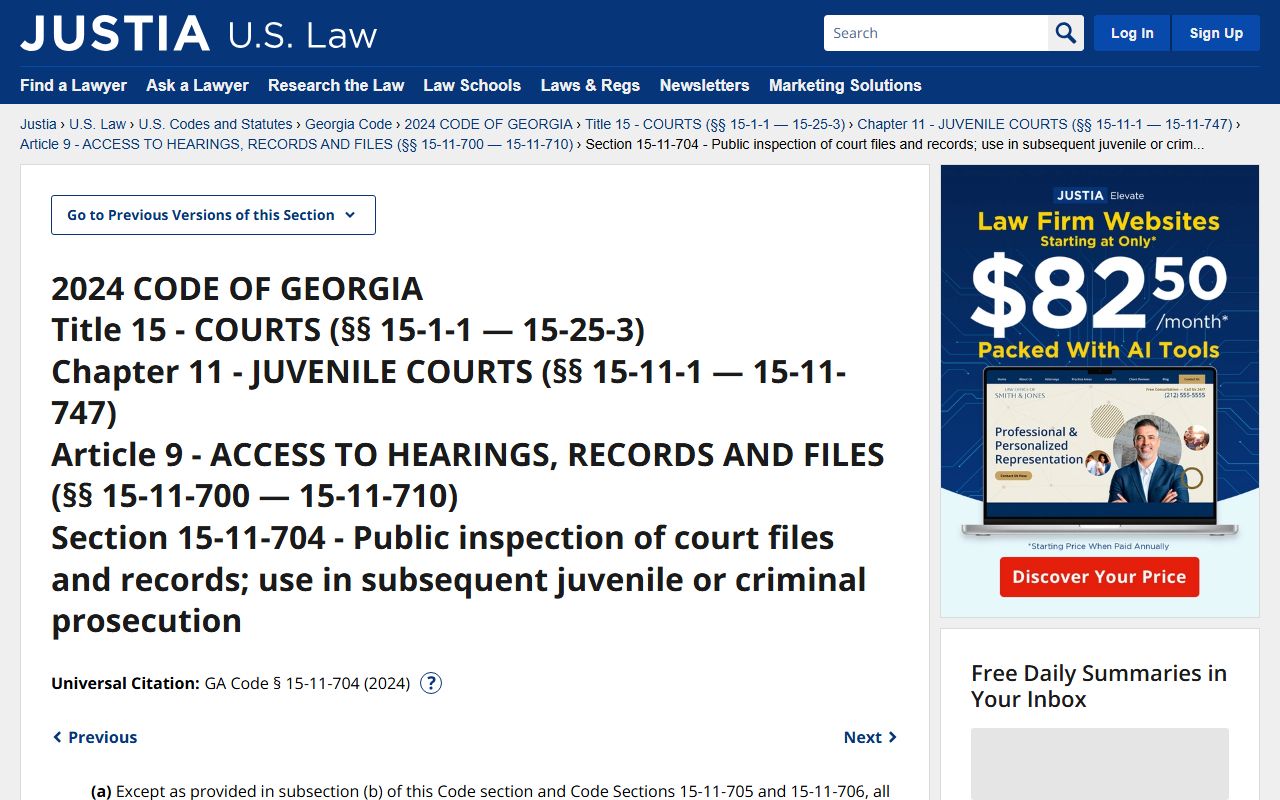
The juvenile statute supports Wayne County's local statement that juvenile court records are not public records for ordinary lookup.
Background Check Considerations
A court-record search is not the same as a regulated employment, tenant, credit, insurance, or licensing background check. A case file may show a charge without showing final statewide criminal-history treatment, or it may show a restricted outcome that requires careful reading. Wayne's Clerk is a court-record custodian, not a broad criminal-history search office. For employment, housing, or other FCRA-regulated purposes, use legally compliant screening procedures and verify information with the originating government office.
Important: Public case lookup should not be used as a substitute for an FCRA-compliant consumer report.
Restricted Criminal Court Records in Wayne County
Restricted criminal records include juvenile matters, sealed cases, restricted criminal-history entries, protected victim or minor information, confidential treatment or mental-health material, and active investigative details that law allows an agency to withhold. Federal criminal cases are separate from Wayne County files and are searched through the U.S. District Court for the Southern District of Georgia and PACER.
The image below comes from the U.S. District Court for the Southern District of Georgia, the federal trial district covering Wayne County.
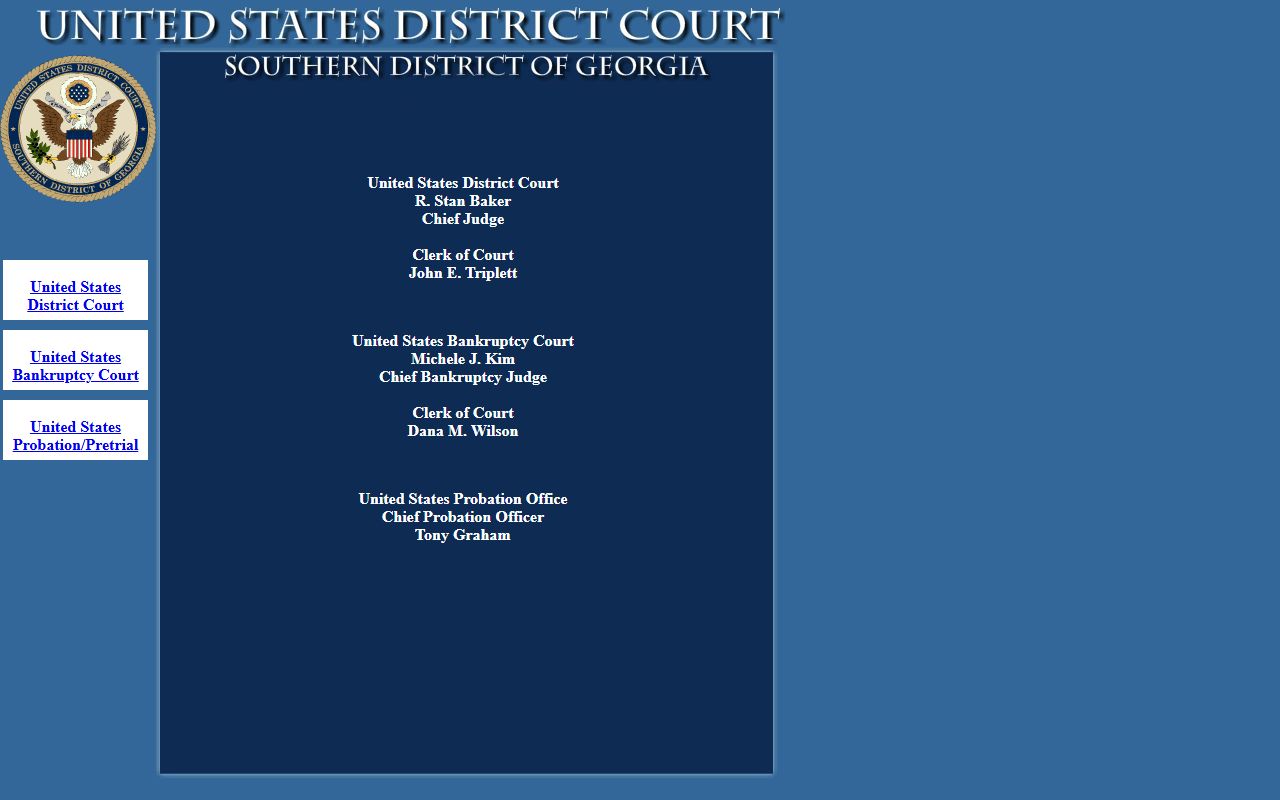
Federal trial records are not held by the Wayne County Clerk, even when the defendant, witness, facility, or event has a Wayne County connection.
The image below comes from the U.S. Court of Appeals for the Eleventh Circuit, the federal appellate court covering Georgia.
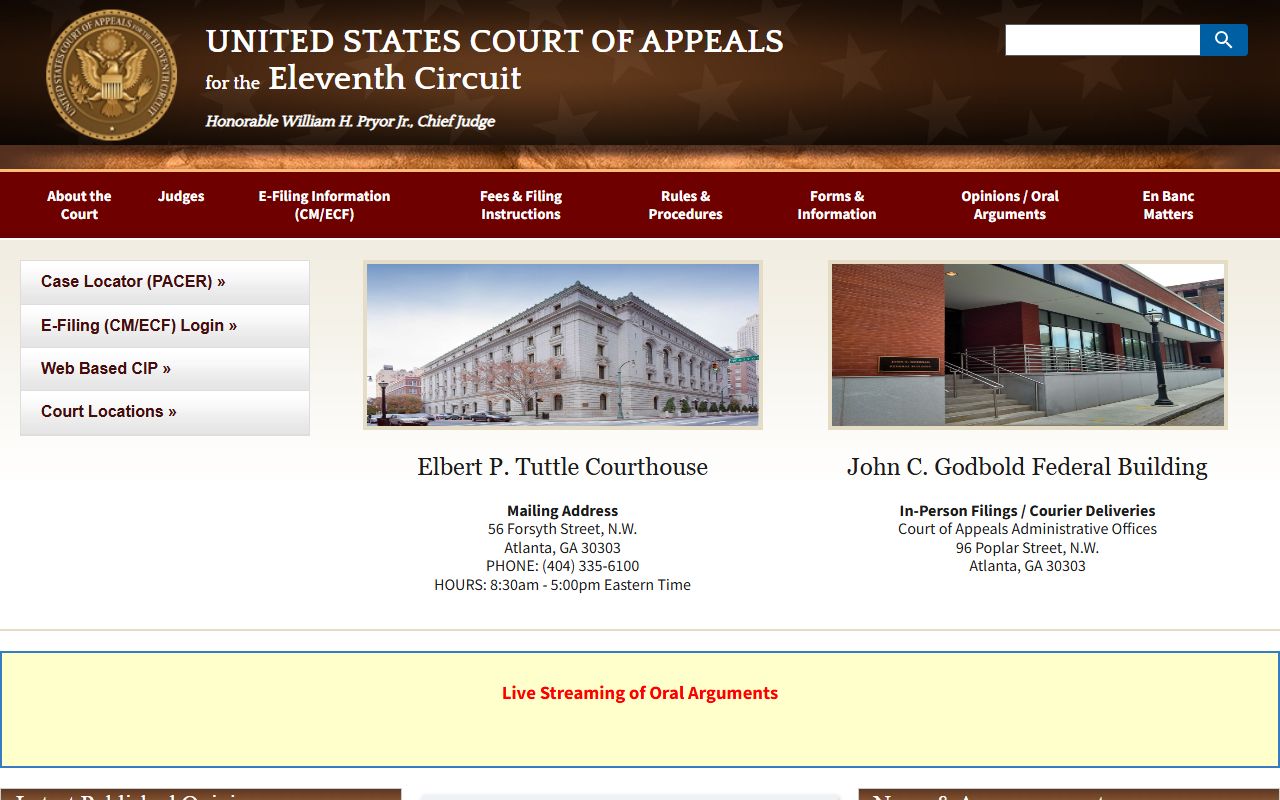
Federal appeals follow the Eleventh Circuit path, while Georgia state appeals generally go to the Court of Appeals of Georgia unless a category goes directly to the Supreme Court of Georgia.
The image below comes from the U.S. Attorney's Office for the Southern District of Georgia, the federal prosecution office for the district.
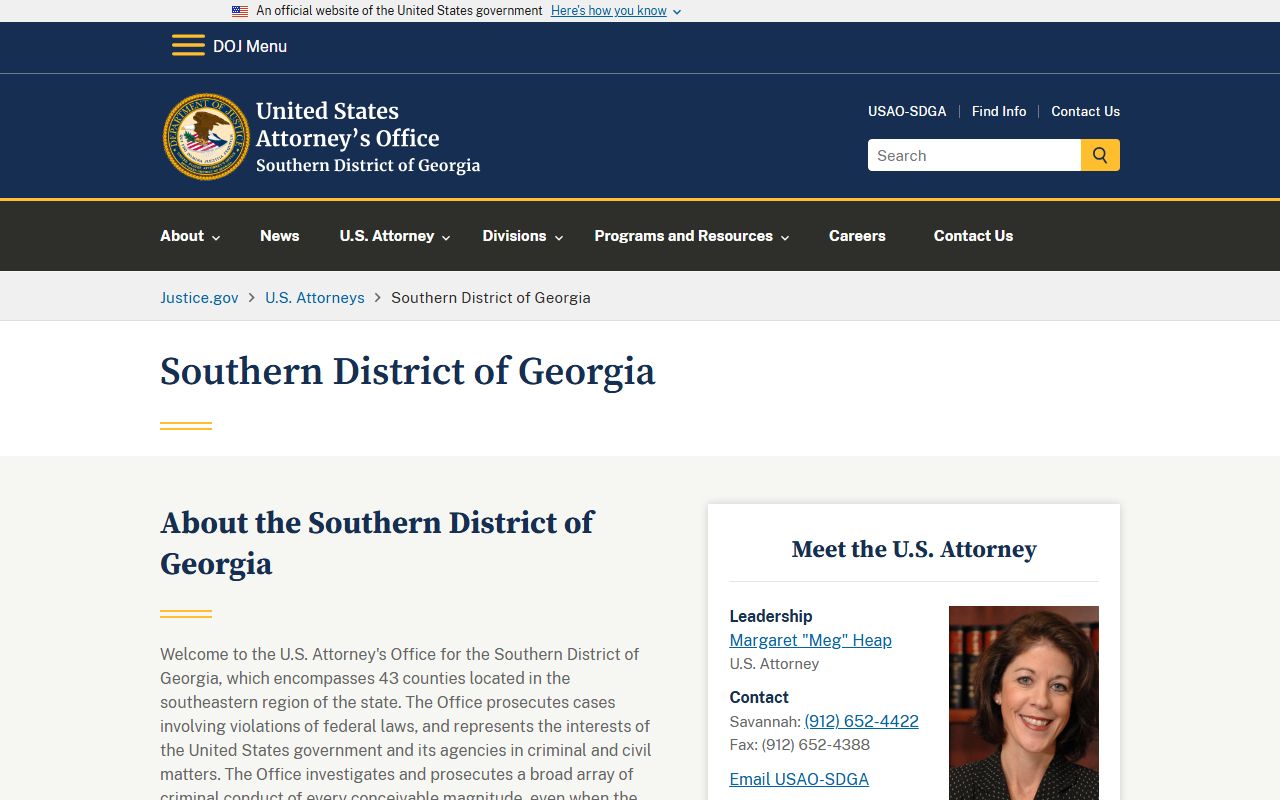
The federal prosecutor source is separate from the Wayne County District Attorney and Solicitor-General offices that handle state felony and misdemeanor matters.