
Wayne County Arrest Records and Court Charges
Wayne County arrest records are usually created by law enforcement and jail staff when a person is taken into custody, identified, photographed, booked, and associated with charges or warrants. The Wayne County Sheriff's Office county page names Sheriff Robert Chuck Moseley, and the sheriff website lists the main office at 266 E Walnut St, Jesup, GA 31546, phone 912-427-5970. The Georgia Department of Corrections location entry lists Wayne County Jail at 1892 South Macon Street, Jesup, GA 31545, phone (912) 427-5975. The public inmate portal is a custody and booking aid, not a final court disposition source.
Court charges after arrest are the formal allegations that move into the court system. They may appear first as booking charges or warrant information, then later as a Magistrate, State Court, Superior Court, or Municipal Court case. The booking charge line can show Warrant No., Counts, Statute, Description, Offense Type, and Court. A full criminal case file can later show accusation, indictment, pleas, motions, hearings, disposition, sentence, fines, probation, restitution, and appeals. For custody status, use jail sources; for the full case file, use the court record and Clerk.
The image below comes from the Wayne County Sheriff's Office county page, the local law-enforcement source tied to arrest and custody questions.
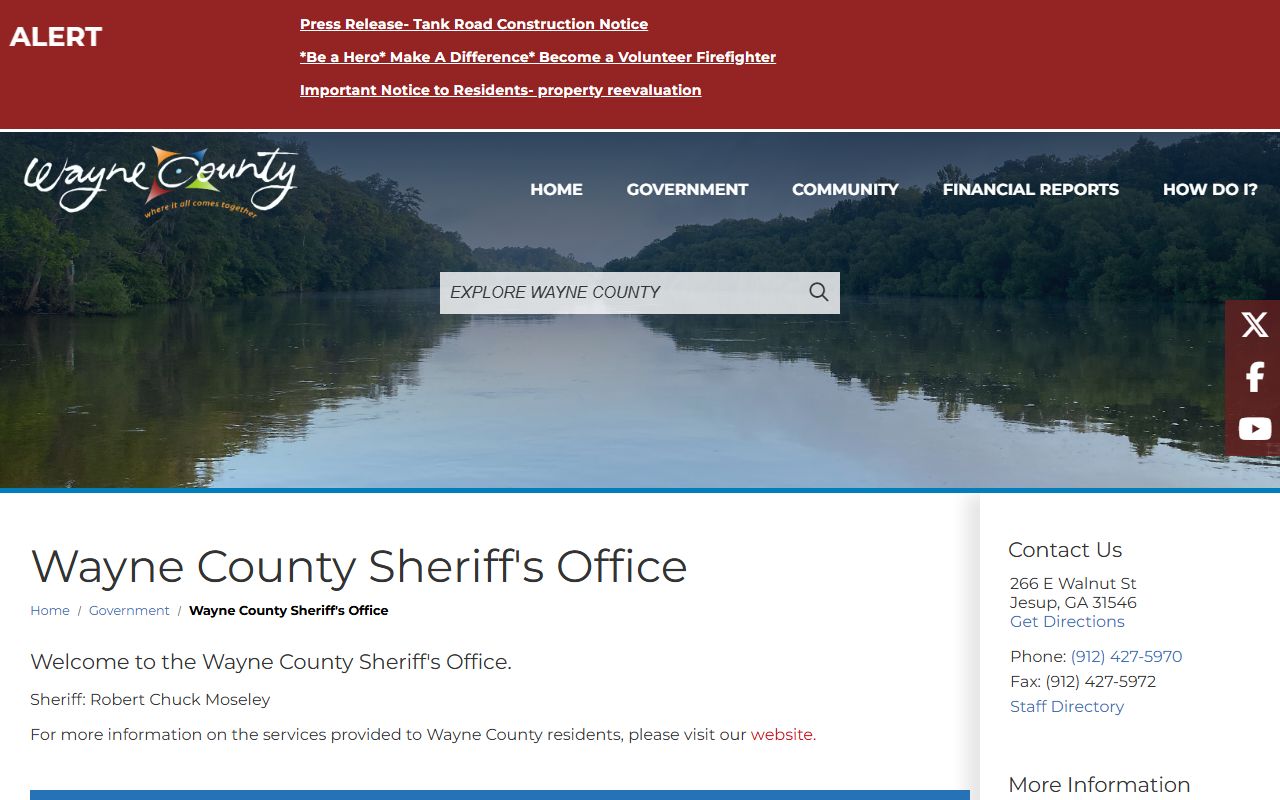
The sheriff source is the starting point for arrest-side questions, while the court and prosecutor offices confirm what charges were filed after arrest.
How to Find Wayne County Arrest Records and Charges
Begin with the question being asked. If the question is whether a person is currently in custody, use the Wayne County inmate inquiry path or call the jail. If the question is an active warrant, contact the Sheriff's Office or the issuing court because no official Wayne County public active-warrant list was located in the reviewed sources. If the question is whether a charge became a court case, use the Clerk of Courts, Georgia e-access / re:SearchGA where available, Magistrate Court, State Court, Superior Court, or Jesup Municipal Court depending on the case.
- Check custody and booking facts through the jail roster or Wayne County Jail if the arrest is recent.
- Record the defendant name, arrest date, warrant number, statute, charge description, offense type, court, and bond information if visible.
- Contact the Clerk or use Georgia e-access / re:SearchGA to see whether the charge became a Superior or State Court case.
- For misdemeanor warrants or transfers, check Magistrate Court and the Solicitor-General's State Court prosecution channel.
- For felony indictments, check Superior Court and the District Attorney's prosecution channel.
The image below comes from the Wayne County civil and transfer fee page, which documents local transfer and filing costs relevant when lower-court matters move into another court.
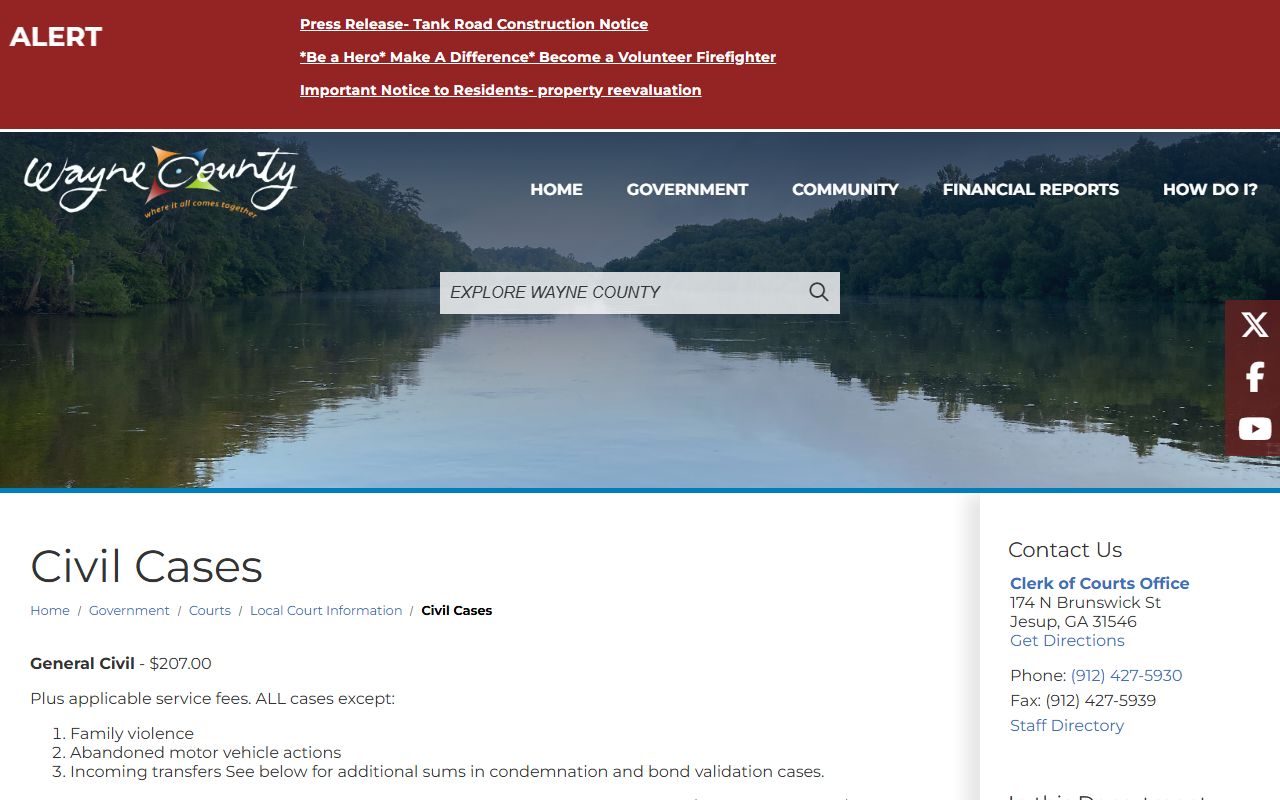
Transfer and filing-cost details help explain why a charge can start in one channel, such as Magistrate Court, and later appear in State Court or Superior Court records.
How Charges Get Filed After an Arrest: Complaint, Information, and Indictment
Wayne County research supports Georgia-specific charging terms. State Court handles misdemeanor accusations. Superior Court handles felony indictments and felony criminal case files. Magistrate Court is important for initial misdemeanor warrants, and the Solicitor-General page says State Court misdemeanor cases include all misdemeanor warrants initiated in Wayne County Magistrate's Office. The District Attorney prosecutes felony criminal matters and serves as legal advisor to the grand jury, which decides whether a true bill or no bill should be returned on indictments.
| Complaint / Warrant / Citation | Accusation / Information | Indictment | |
|---|---|---|---|
| Filed By | Officer, court, or initiating agency depending on the matter | Prosecutor, commonly the Solicitor-General for State Court misdemeanors | Grand jury after presentation by the District Attorney |
| Common For | Arrest, warrant, citation, or initial lower-court routing | Misdemeanor criminal cases in State Court | Felony criminal cases in Superior Court |
| Wayne County Route | May begin with Sheriff, jail, Magistrate Court, municipal, or citation activity | State Court misdemeanor accusation and traffic prosecution | Superior Court felony case in the Brunswick Judicial Circuit |
| Record Use | Identifies arrest-side charge, warrant number, statute, court, or citation | Creates the formal misdemeanor court charge record | Creates the formal felony court charge record |
Charge Status and What It Means
Charge status can change as prosecutors, courts, and judges act. A booking charge may be pending while the prosecutor decides what to file. A filed charge may be amended, reduced, dismissed, nolle prossed, dead docketed, transferred, or resolved by plea or trial. The status should be read with the court, docket date, and disposition. A single arrest can produce multiple counts with different outcomes.
| Status | What It Means |
|---|---|
| Pending | The charge or case has not reached a final disposition, or the visible booking record has not been matched to final court action. |
| Amended / Reduced | The original charge changed, often by prosecutor action, plea negotiation, or court order. |
| Dismissed | The charge ended without conviction; confirm whether other counts or related cases remain active. |
| Nolle Prosequi | The prosecutor declined to continue the charge, often shown as nolle pros or nolle prossed in records. |
| Dead Docket | The case is made inactive under Georgia practice; do not assume ordinary dismissal without court confirmation. |
| Convicted / Sentenced | The charge resulted in guilt and a sentence such as confinement, probation, fines, fees, restitution, or program terms. |
Charges vs. Convictions
Being charged is not the same as being convicted. An arrest record or booking profile may show the charge description supplied at booking, while the court file later shows whether the prosecutor filed the same charge, changed it, dismissed it, or proved it. A conviction requires a guilty plea, verdict, or other final guilty disposition. Court users should read charge status and disposition together.
| Charge | Conviction | |
|---|---|---|
| Stage | Arrest, warrant, citation, accusation, or indictment stage | Final guilty plea, verdict, or other guilty disposition |
| Proof Level | May reflect probable cause or a prosecutor charging decision | Requires plea or proof beyond a reasonable doubt |
| Public Record | May appear in booking, warrant, docket, or court charge data | Appears in disposition and sentencing records unless restricted |
| Practical Meaning | An allegation or formal filed count | A court outcome that can carry sentence, probation, fines, and collateral consequences |
Sealed vs. Expunged Records
Georgia often calls this record restriction, not expungement. O.C.G.A. 35-3-37 governs restriction and sealing of criminal-history records. A person usually starts by identifying the arrest, charge, court, arresting agency, and disposition. Dismissed charges, nolle prosequi, dead docket, acquittal, certain youthful matters, or other statutory categories may qualify. Convictions are more limited and may require a court petition.
| Sealed / Restricted | Expunged | |
|---|---|---|
| Visibility | Limited from ordinary public criminal-history access or court access under law | Georgia commonly treats relief as restriction rather than promising destruction of every record |
| Law Enforcement | Authorized agencies may retain access for specified purposes | Private copies and jail or court traces may not vanish automatically |
| Eligibility | Depends on charge outcome, age, offense category, petition requirements, and court jurisdiction | Convictions are harder to remove and require careful statutory review |
Charge Codes and Severity Levels
The Wayne inmate portal charge grid is configured to show Warrant No., Counts, Statute, Description, Offense Type, and Court. Counts explain how many separate allegations exist under a charge line. Statute and description identify the legal charge. Offense Type can indicate whether the matter is felony, misdemeanor, or another category when populated. Court indicates where the charge is routed or associated. Total Bond appears at the profile level, while per-charge bond was not confirmed in the template.
Wayne County's charge routing is especially detailed for misdemeanors and traffic. State Court misdemeanor matters include warrants initiated in Magistrate Court; traffic citations from the Sheriff's Department, Board of Education Police, Georgia State Patrol, Georgia Department of Natural Resources, county park rangers, and animal control; District Attorney transfers; Macon Municipal Court transfers; and Magistrate transfers. Serious traffic offenses such as DUI, suspended license, fleeing or eluding, and leaving the scene require court involvement and are not ordinary payable tickets.
Statewide Charge and Criminal History Lookups
Statewide criminal-history access is separate from Wayne County arrest records and court charges. The Clerk of Courts does not perform broad criminal-history searches from misdemeanor or felony files. A court user should request a specific case or disposition from the court, then use Georgia criminal-history channels when a statewide background result is needed. Georgia Open Records Act provisions may help with agency records, but exemptions apply to confidential, restricted, juvenile, active investigative, and privacy-sensitive material.
The image below comes from O.C.G.A. 50-18-70, Georgia's Open Records Act definitions and intent provision.
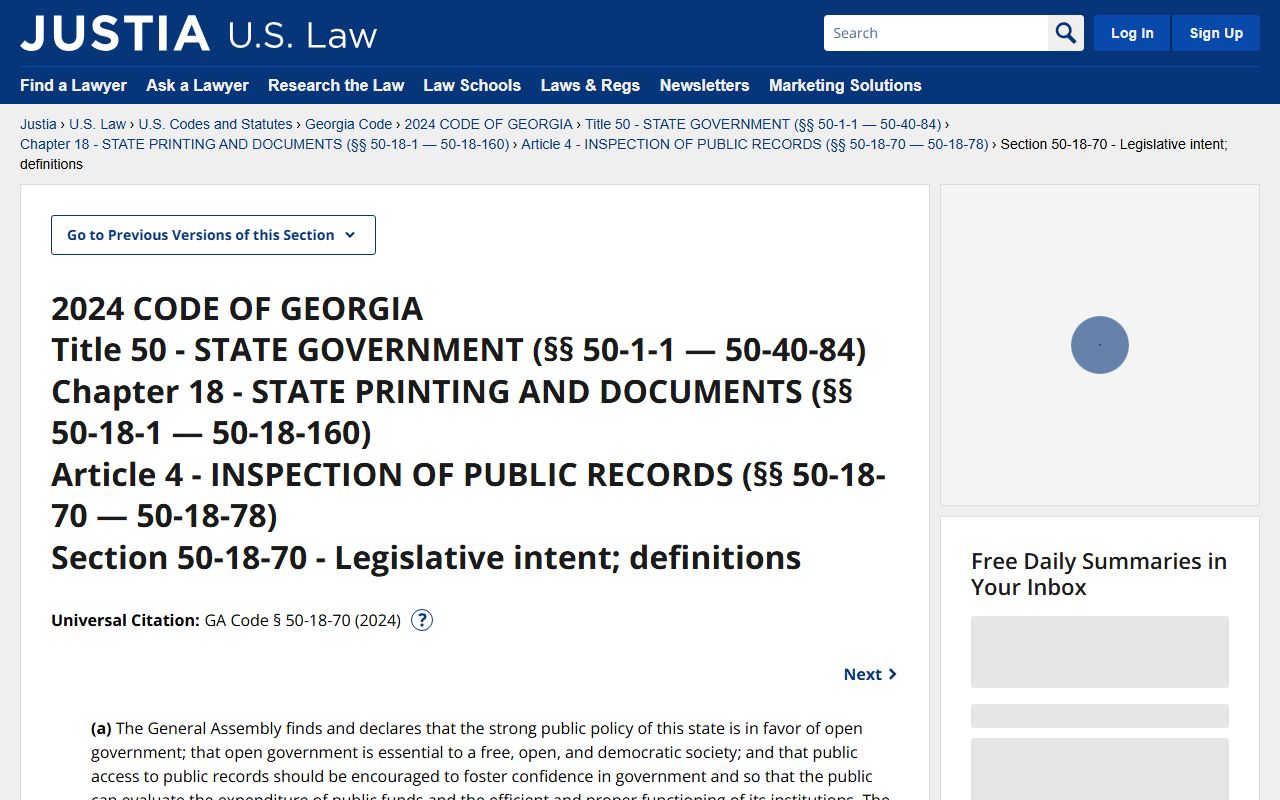
The open-records statute helps with public agency records, but it does not override court orders, juvenile confidentiality, record restriction, or statutory exemptions.
Background Check Considerations
Arrest and charge lookups can be incomplete if used as background checks. A booking record may show a charge before the prosecutor changes it. A docket may show an accusation or indictment before final disposition. A court file may show dismissal or restriction that a private database misses. For employment, tenant, credit, insurance, or other regulated decisions, use legally compliant background-check procedures and verify with the originating government office.
Important: Arrest and charge records should not be treated as FCRA-compliant consumer reports.
Restricted Charge Records in Wayne County
Restricted charge records include juvenile matters, sealed cases, restricted criminal-history entries, protected victim or minor information, confidential treatment or mental-health material, and records tied to active investigations or sealed warrants. Wayne County explicitly says juvenile court records are confidential and are not publicly accessible. The inmate roster can help with current custody and booking-level charge data, but it does not replace court confirmation of charge status, disposition, bond terms, or sentencing.